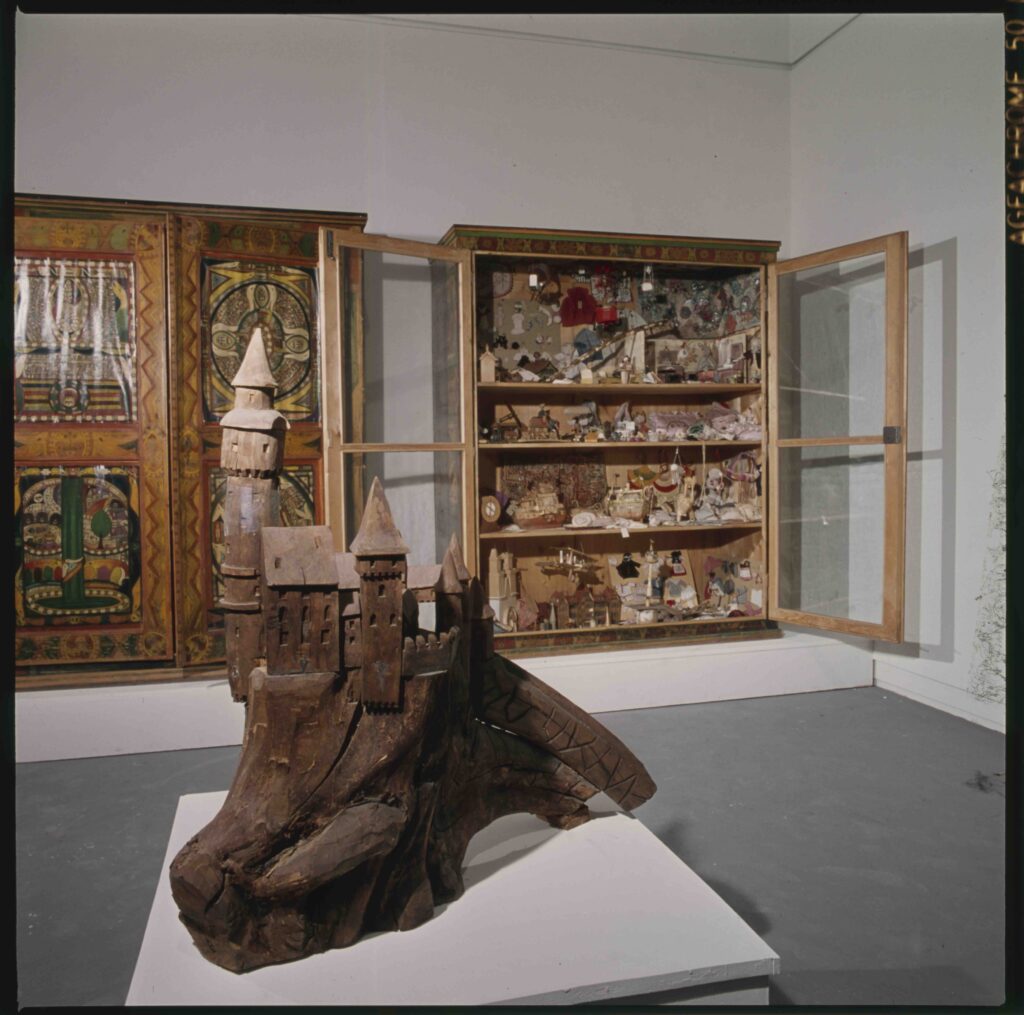
The Bernese psychiatrist Walter Morgenthaler (1882–1965) began collecting artworks created by patients, as well as everyday objects from psychiatric institutions, as early as 1913. This ‘Morgenthaler Collection’ forms the heart of the museum’s collection. Alongside the Prinzhorn Collection in Heidelberg and the Collection de l’Art Brut in Lausanne, it ranks among the most important collections of so-called ‘outsider art’ or ‘art brut’ created before 1945, produced without having yet been influenced by the expectations of the art market.
Morgenthaler paid particular attention to Adolf Wölfli (1864–1930), several of whose works he included in his collection. Wölfli also painted display cabinets and cupboards, which are on display at the museum. The collection comprises around 5,000 works by some 300 patients. Among them are Constance Schwarztlin-Berberat (1845–1911), Heinrich Anton Müller (1869–1930), Hans Fahrni (1874–1939) and Rosa Marbach (1881–1926), as well as lesser-known artists such as Oskar Bütikofer (1860–1925), Lina Cécile Colliot Schaffter (1867–1937), Louise Deci (1846–1919), Marie von Fischer-von Sinner (1868–1956), Marie Füri (1893–1929), Friedrich Kohler (1875–1960), Emma Marti (1870–1949) and Karl Schneeberger (1880–1948). Only a tiny fraction of the works is on display at the museum.
With his book ‘Adolf Wölfli. Ein Geisteskranker als Künstler’ (Adolf Wölfli: A Mentally Ill Person as an Artist), published in 1921, Morgenthaler brought Wölfli and the art of psychiatric patients to the attention of a wider audience and provided a decisive impetus to the artistic avant-garde of the interwar period. The collection attracted renewed attention thanks to Jean Dubuffet from the 1940s onwards, and later to Harald Szeemann, who reconstructed Wölfli’s cell at Documenta 5 in Kassel in 1972 and dedicated a room in the small Waldau Museum to other works from the collection.
From 1963 onwards, Heinz Feldmann, a member of staff in the Waldau’s technical department, took charge of the collection and began to expand it with around 5,000 objects relating to the day-to-day life and operations of the clinic, such as research instruments, farm equipment, beds, electrical installations, etc.
With the reopening of the former museum under the name ‘Bern Museum of Psychiatry’ in 1993, the collection of works of art was resumed, with a focus on former patients of the clinic, many of whom worked – and continue to work – in the Waldau art workshop. These include, in particular, Daniel Curty (1960–2013), Ursula Demmler (born 1962), Gabor Dios (1953–2020), Annemarie Flückiger (born 1945), Martin Flückiger (born 1970), Marco Güdel (born 1983), Gordian Hannemann (born 1958), Hermann Kammer (1922–1987), Winfried Keusch (1934–2006), Heinz Lauener (born 1977), Bruno Layer, Louisa Johanna Morgentau (born 1962), Margrit Roth (1955–2013), Philippe Saxer (1965–2013), Jonas Scheidegger (born 1981).
Most of the main Morgenthaler collection is catalogued in a database, whilst the remainder is largely recorded on index cards. Currently (2026), a major project is being planned to improve the storage and cataloguing of the entire collection. In the medium to long term, the collection is expected to be accessible online.
For further information, see the Wikipedia article on the Morgenthaler Collection.